



NSM Series, edited by Ursula Werther-Pietsch
The new series New School of Multilateralism, Nomos Publishing House, addresses today's geopolitical problems and develops new perspectives on international relations.
In the first volume, the "world net order" for the renewal of the rules-based order was presented by the editor at the NSM Xmas Meeting at Konrad Adenauer Foundation in Vienna in 2024. Further volumes followed on global great power strategies, democracy support, AI and human rights or energy security - see below!
The series accompanies the Master programme Global Studies at the University of Graz. The volumes are subject to an academic review process and published from 2025 to 2027.
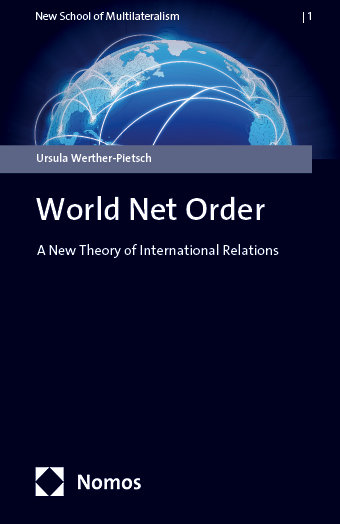
FOUNDATIONAL VOLUME
The book presents a theory on potential peaceful evolution of international relations in the upcoming years and is the inaugural volume in a series on New Multilateralism.
To achieve this, it employs anticipatory thinking, an ideas lab, structured discussions, and a thorough knowledge accumulation process, drawing from both scholars and practitioners since 2012. Along the way, it has been enriched by emerging topics, such as the impact of AI on free media, while addressing the increasingly urgent quest for global solutions.
"The World Net Order" encapsulates a decade's worth of research aimed at providing a comprehensive answer to contemporary questions, specifically through a trilogy of works: "Powering Universalism" (Klein Publishing House), "Transforming Security" (Springer), and "Envisioning Peace in a Time of War" (Facultas), as detailed in the NSM Library.
In revisiting peace and security matters, the founder of the NSM Ursula Werther-Pietsch further developed her Habilitationsschrift (Friedensicherung, Selbstbestimmung und Gewaltverbot, nwv 2012). The guiding concept of 'Multilateral System Thinking', as presented by the author, builds on the thoughts of professors and diplomats, i.a. Konrad Ginther, Felix Ermacora, Georg Lennkh, Irene Giner-Reichl, Anne Peters, Daniel Thürer and Martti Koskenniemi.
UN USG Melissa Fleming, UN Under Secretary General for Global Communications
Our world is in crisis.
We face challenges on every front. Wars, the threat of nuclear confrontation, forgotten crises, barbaric acts with appalling civilian toll, brutal retaliation, and risk of escalation. More people died in conflicts around the world in 2023 than during any year in the past three decades. A quarter of humanity now lives in conflict-affected areas, with devastating impacts on millions of lives and livelihoods.
Inequality and joblessness continue to rise, human rights and democracy are under attack. The Covid-19 pandemic set back progress on the United Nations’ Sustainable Development Goals. Misinformation, disinformation and hate are poisoning our information ecosystems. Climate disasters grow more frequent, more expensive, and more deadly. Our vision for a better world is in trouble.
Acting together, the international community can address these problems.
The upcoming Summit of the Future aims to create a new multilateralism embracing a multipolar world, countering major power competition and deepening collaboration where joint efforts are needed. The related outcomes – the UN Global Principles for Information Integrity, as well as the Pact for the Future, the Declaration on Future Generations and the Global Digital Compact, present a new blueprint to respond to today’s challenges. Meanwhile, under the banner ‘UN 2.0’ the Secretary-General has put forward a vision of a rejuvenated organization equipped with cutting-edge expertise and technology that can breathe new life into our common efforts.
We place our hopes in the Summit of the Future in New York in September 2024 and a revitalized United Nations, that will bring the world forward towards peace and prosperity on a healthy planet.
Ursula Werther-Pietsch holds the position of Visiting Professor at the University of Graz, Austria. She teaches international law and international relations at the University of Graz and the University of the German Armed Forces in Munich. Additionally, she has taught at the University of Vienna, the Vienna Diplomatic Academy, and the Austrian Defence Academy. Ursula is a member of the German Society for International Law, the Scientific Commission of the Austrian Federal Ministry of Defence, and the board of the International Institute for Peace (IIP). She is the co-editor of The Defence Horizon Journal Special Edition, which she co-founded in 2021. Serving as a long-term scientific advisor to the Academic Forum for Foreign Policy (YUNA), she is since 2023 the Co-chair of an EU-wide network on Media and Digital Transformation (Team Europe Democracy, TED). Her research delves into collective security, human rights, human security, peacebuilding in fragile contexts, resilience, multilateral system thinking, human centrism, and anticipatory governance. Her most recent publications include Powering Universalism (ed., Klein 2021), Transforming Security (Springer 2022), and Envisioning Peace in a Time of War (ed., Facultas 2022).
For additional information, you can visit her on LinkedIn, YouTube, and Wikipedia. :)
NSM Series Volume 2:
The Multipolar Turn. Global Strategies and Power Projections
How to deal with evolving alternative concepts of multilateralism? In an era of dense global interdependence, multilateralism is significantly influencing government behaviour, compelling countries to adopt cooperative strategies, norms, and agreements in addressing issues ranging from climate change to trade and human rights. At the same time, they must navigate complexities such as sovereignty concerns, polarisation and geopolitical competition.
Crafting a foreign policy that effectively balances national ambitions and universal obligations means exploring the complex interplay of power dynamics, differing value systems, and the reflections of one’s respective identity. The USA, China, the EU, Russia, and India, as predominant actors on the global stage, are all advocates of multilateralism but pursue different paths in their foreign policy actions, some of them specifically focusing on developing countries with a "no-strings-attached" approach. Development is an area where this can be particularly far-reaching, as it can severely influence partner countries' policies and hinder the global promotion of democracy.
Considering their specific political contexts, what are partners aiming for, how can we better understand their pursuit of following national interests, while also striving for international legitimacy? Do we have the same perception of human rights or terms like “inclusivity”? Why is democracy sometimes not “the only way”? As the world becomes more interconnected, proactive engagement in multilateral frameworks will define national success in global and domestic governance. It is therefore as vital to think about the consequences of these different strategies for world politics as it is for domestic politics and different endeavours in the field of governance.
Carla Fetcas studied Law and Russian at the Universities of Graz and Geneva. During her studies, she worked on topics such as development, peace, and human rights in various settings, including the German Development Cooperation or the Permanent Mission of the USA to the OSCE.
Martin Kreutner is spiritus rector and First Dean (emeritus) of the International Anti-Corruption Academy (IACA).


NSM Series Volume 3:
Gesellschaft und Krise
Der Philosoph Jürgen Habermas (*1929, † 2026) hat die moderne Gesellschaft als ein Projekt verstanden, dessen Zusammenhalt wesentlich davon abhängt, ob Konflikte durch vernünftige Verständigung und demokratische Willensbildung bearbeitet werden können. In der heutigen Zeit jedoch haben viele Menschen den Eindruck, dass diese Bedingung nicht mehr erfüllt werden kann. Durch die seit dem späten 20. Jahrhundert voranschreitende Digitalisierung und die flächendeckende Verbreitung von Computern und Smartphones dringen Fehden, die oft zwischen verhärteten Fronten ausgetragen werden und eine eigene, oft destruktive Kommunikationslogik besitzen, zunehmend in das alltägliche Leben ein. Das Gefühl der gesellschaftlichen Polarisierung greift um sich. Angesichts dieser Lage wächst bei vielen Menschen das Bedürfnis nach friedlicheren Verhältnissen, wie sie mutmaßlich in den Gesellschaften der Vergangenheit bestanden haben. Obzwar es naiv wäre, anzunehmen, dass „früher alles besser“ war, muss diese weit verbreitete Verunsicherung doch ernst genommen werden. Gesellschaft und Krise versucht daher, die Strukturprobleme modernisierter Gesellschaften im Hinblick auf den sozialen Frieden sichtbar zu machen, um die Frage aufzuwerfen, ob sie mit den Mitteln der Demokratie hinreichend bewältigt werden können.
Alexander Strupp studierte von 2014 bis 2021 in Freiburg im Breisgau, Heidelberg und Wien Philosophie und Germanistik sowie seit 2022 Publizistik- und Kommunikationswissenschaft. Seine Abschlussarbeiten widmete er zum einen den erziehungspolitischen Elementen in der praktischen Philosophie des Aristoteles (Bachelor), zum anderen der Sozial- und Rechtsphilosophie von Jürgen Habermas (Master). In den Jahren 2022 und 2023 absolvierte er das Global Advancement Programme der Österreichischen Gesellschaft für Außenpolitik und die Vereinten Nationen (ÖGAVN). Neben der philosophischen Auseinandersetzung mit gesellschaftlichen und politischen Themen beschäftigt sich Strupp vor allem mit anthropologischen und kulturphilosophischen Fragen. Seit 2024 promoviert, lehrt und forscht er an der Universität Wien sowie der RPTU Kaiserslautern-Landau mit einem Schwerpunkt auf der Philosophie von José Ortega y Gasset; seit 2025 ist er zudem Mitarbeiter im Projekt „Mensch und Phantasie“ am Institut für Interkulturelle Religionsphilosophie an der Universität Wien. 2025 bis 2026 war er Research Fellow am Institut für die Wissenschaften vom Menschen (IWM) in Wien, und bis Ende des Jahres 2026 ist er DOC-Stipendiat der Österreichischen Akademie der Wissenschaften (ÖAW).
NSM Series Volume 4:
On a Restart of Economic Multilateralism
In November 2024, the world's multilateral order, established after World War II, took its final blow. With the election of Donald Trump as the 47th President of the United States, American voters consciously or unconsciously chose "America First" and buried the multilateralism we knew. Since the end of globalization around 2010, the world has slowly divided into blocs that emphasize their differences and competition with each other more than the potential gains from trade and other forms of cooperation. A world economy including about four billion people in an economic system based on division of labor certainly needs a multilateral order. The "Keynesian" institutions introduced after World War II were effective for a time, but ultimately proved unsuitable for a drastically changed world after the end of colonialism and the Cold War.
The multilateral trading system established after World War II was built around the idea of gains from trade. At the heart of the GATT/WTO system is the "most favoured nation" (MFN) clause. This clause ensures that each participant receives no worse treatment than any other partner country in every bilateral relationship. The multilateral order was extremely successful. It helped millions of people escape extreme poverty. However, it was the system's success and dynamics that created discomfort. Correcting inequalities within a society is difficult. For many people, it seems simpler to fight foreigners who "exploit" the home population. The USA, the country with the largest market in the world and the country issuing the world's reserve currency, has made protectionism the means of its power politics. Other powerful countries will follow suit if this becomes the new mode of international operation.
The United Nations-based order was designed remarkably flexible. It was created in response to the failure of the Treaty of Versailles and the subsequent period of disintegration, competitive devaluations, and war. Particularly Keynes, but other also economists, have worked on an integrating international system that allows for national sovereignty in economic affairs and international stabilization. Three multilateral organizations (WTO, IMF and the World Bank) are the backbones of the system. President Trump, in contrast, proposes a deal-based system of international relations with every country looks out for its own benefit. The tariffs introduced on the Liberation Day shall improve the U.S.'s terms of trade and tax imports to raise revenue for the federal government. President Trump aims to achieve three goals: to stopping the deindustrialization process in the U.S., to improving the current account and to generating revenue. He will fail to achieve any of these goals and will ruin the multilateral system in which we have prospered in for the last 70 years.
President Trump will fail because the division of labor is now global. Gains from trade result from the advantages of specialization. This is why we need a new multilateral order. We should not forego these gains. They are substantial. The old order cannot be repaired, so we need a new one that fits the state of the world economy in 2026. While I cannot foresee the new arrangements, I stated some criteria collected by Rodrik (2011) to guide the search for them.
The book will be published in October 2026.
Jörn Kleinert is a professor of international economics with over 20 years' experience in the field. His theoretical work focuses on general equilibrium models with heterogeneous agents, while his empirical work involves large micro data sets. Recently, his research focus has turned to the emergence and development of institutions in general, and markets in particular. Having studied and worked in Kiel and Tübingen, Germany, he joined the University of Graz in 2010.

NSM Series Volume 5:
Contested Democracy
The book will be published in November 2026.
Foreword
Democracy is not self-evident. It never was. But in recent years, its foundations have been shaken with a speed and ferocity that ought to alarm anyone who cherishes the open societies we have built together over the past decades. One-sided geopolitical and economic power politics, the weaponisation of information and technology, the creeping normalisation of democratic backsliding — these are not distant threats but present realities demanding a swift resolute response.
"Democracy Now" is both a title and an imperative. This book examines what democracy means in today's world, and what it takes to preserve and renew it. What strikes me most is its refusal to be despairing. Across all chapters runs a deep conviction that democracy adapts and learns. It survives and prospers, not passively, but because citizens and institutions actively fight for it.
As a country whose own democratic history includes both the darkest of warnings and the brightest of recoveries, Austria's engagement matters. We have learned the hard way what it costs to give up democracy, and how much it takes to rebuild it. This experience carries an obligation: to be not merely a consumer of the international democratic order but one of its proactive co-authors.
The Agora, the ancient Greek public space where citizens gathered to deliberate and decide, has always been more than a metaphor. It stands for a commitment: to openness, to argument, to the deep-rooted belief that governments’ power derives from the consent of those governed. In the multilateral disorder of our times, Europe must be the guardian of exactly that commitment.
Vienna, 2026
Beate Meinl-Reisinger,
Austrian Federal Minister
for European and International Affairs
The Library. NSM Papers
Die internationale Ordnung ist in Bewegung, soviel ist sicher – aber wohin bewegt sie sich zwischen Energiekrisen, wachsender Ungleichheit und atomarer Bedrohung? Keine der Grand Theories der Politikwissenschaft hat es bisher geschafft, die turbulenten Dynamiken der letzten 30 Jahre seit dem Fall der Berliner Mauer ausreichend zu erklären (Wolfgang Petritsch). Der Weg in die Zukunft weist eine hochgradige Komplexität auf, die Unsicherheit hervorruft. Aber auch als Chance wahrgenommen werden und einer geopolitischen Spaltung entgegenwirken kann.
Mitgeschrieben haben Bea Austin, Berghof Stiftung, Berlin, Martin Kreutner, unabhängiger Konsulent und ehem. Dekan der IACA, Thomas Greminger, OSCE Generalsekretär a.D. und Exekutivdirektor des GCSP, Heinz Gärtner, Professor un Institutsleiter Politikwissenschaft, Wien, Velina Tchakarova, Forsight Expertin, Michael Staudinger, Direktor a.D. Geosphere Austria (ZAMG), Florian Weinreich, Student der Philosophie, Universität Wien and Fulbright-Stipendiat (San Jose State University, Silicon Valley).
Universität Graz, unipub, Open Access Pulikationsserver: https://doi.org/10.25364/404.2023.1
Democratic governance in global affairs, under pressure for two decades, arrived at an inflection point. This includes a fundamental challenge of the transatlantic axis, a huge hollowing out of state administration and the dissolution of USAID with the probable consequences of rising autocratic influence globally. As many societies undergo transitions to severe autocratic rule and/or become hyper-fragmented and polarised, donors must better address the potential for free coalition building and explore effective ways of maintaining space for public dialogue. Discovering scenario-based approaches in conjunction with a set of red flags to detect systemic repression can help identify windows of opportunity for change, relying on democracy’s surprisingly strong power of resilience.
After the securitisation of everything, a new simplification of international cooperation runs ram-pant, the hammer of economisation of international relations. Multilateralism which is narrowed down to be a wing man of economic relations loses its vision. But societies' peaceful future still lies in democracy which empowers a self-determined life as a value in-itself.
A TDHJ Special Edition analysis by Ursula Werther-Pietsch and Carla Fetcas, 2/2025
There is an urgent need of responsiveness and structural reform in the international sphere. Recent breaches of international law, a geopolitical resetting, and dysfunctional norm-setting led to massive losses of trust and credibility in the multilateral arena. All in all, the transformative triangle that underpins a new theory of international relations is built by the dimensions of democratisation, regionalisation, and a renewed universal commitment to Peace.
Die Friedens-Warte Vol. 96, 2023, issue 1-4, 144-164
DOI 10.35998/fw-2023-0008
UN Secretary-General Antonio Guterres‘ call for reform is timely, if not overdue. Dysfunctionality and polarisation characterise established multilateralism. China, Russia, the “West” and the new “in-betweeners” are pursuing a dominant logic of realpolitik, systemic competition and rival bloc formation. Democracies are no longer in the majority. Life worlds are breaking apart and multilateral fora are less and less able to act as mediators. Consequentially, there is a gulf between global power and responsibility. Therefore, an international order that takes account of the non-state and regional dimensions is becoming increasingly urgent.
Zeitschrift für Öffentliches Recht, ZÖR 2024, 147 Heft 1
The Quest for Peace in a World of Blocs and Poles is our duty, Stefan Zweig may have characterised what mankind after WWII should best keep in mind. Analyzing the disputed “Given” and turning to the “Envisioned” a few months after the Russian aggression against the Ukraine, this book is an early powerful response to the new age of unpeace, striving for strengthening international cooperation and lying the foundations of the NSM in a still fragile moment of history.
Ten eminent people from practice and theory of which Karina Jasmin Karik, University of Vienna, Walter Kemp, OSCE, Wolfgang Petritsch, former Secretary of State and Chief negotiator of Rambouillet peace agreement on the Western Balkans, Michael Reiterer, Université Libre de Bruxelles, Raquel Esther Jorge Ricart, Real Instituto Madrid, Fred Tanner, Geneva Institute, Johannes Varwick, Universität Halle-Wittenberg, or Juliette Wiegmann, Berghof Foundation, contributed to this topical piece of thinking.
Werther-Pietsch (ed.), Envisioning Peace in a Time of War, New School of Multilateralism, 10 Essays. Facultas, 2022
The author examines the collective security system as it now stands, focusing on strategic and normative frameworks, offers practice-driven research perspectives in the field of peacekeeping and frames a post-COVID-19 world of adapted global intervention.
Werther-Pietsch, Transforming Security, A New Balance-of-Power Doctrine. Springer, 2022
The autocratic challenge to democracies, a two-systems rivalry, large dominance of realpolitik and the emergence of big tech powerhouses as global players are the strategic matches of our times. To this adds the COVID-19 pandemic as a poly crisis, for some, the end of the Unit-ed Nations. How would a digitalised, environmentally sustainable and gender-sensitive world look like in 2050? In the manifesto “Future Global Governance”, more than 30 co-authors revisit the changed context for multilateralism and view new forms of anticipatory human-centred governance. The book re-examines universalism, strategic autonomy and resilience against today’s power projections.
Werther-Pietsch (ed.), Powering Universalism. Klein pulishing house, 2021
The NSM Series offers a reality-check of multilateralism now. Founded in an era of global uncertainty and growing conflict, the aim is to reinvent ways of international cooperation. The next volume could reflect your ideas in the field of NSM! Correspondence: Ursula.werther-pietsch@univie.ac.at.